

Battery storage · 8-minute read · Updated 13 November 2026
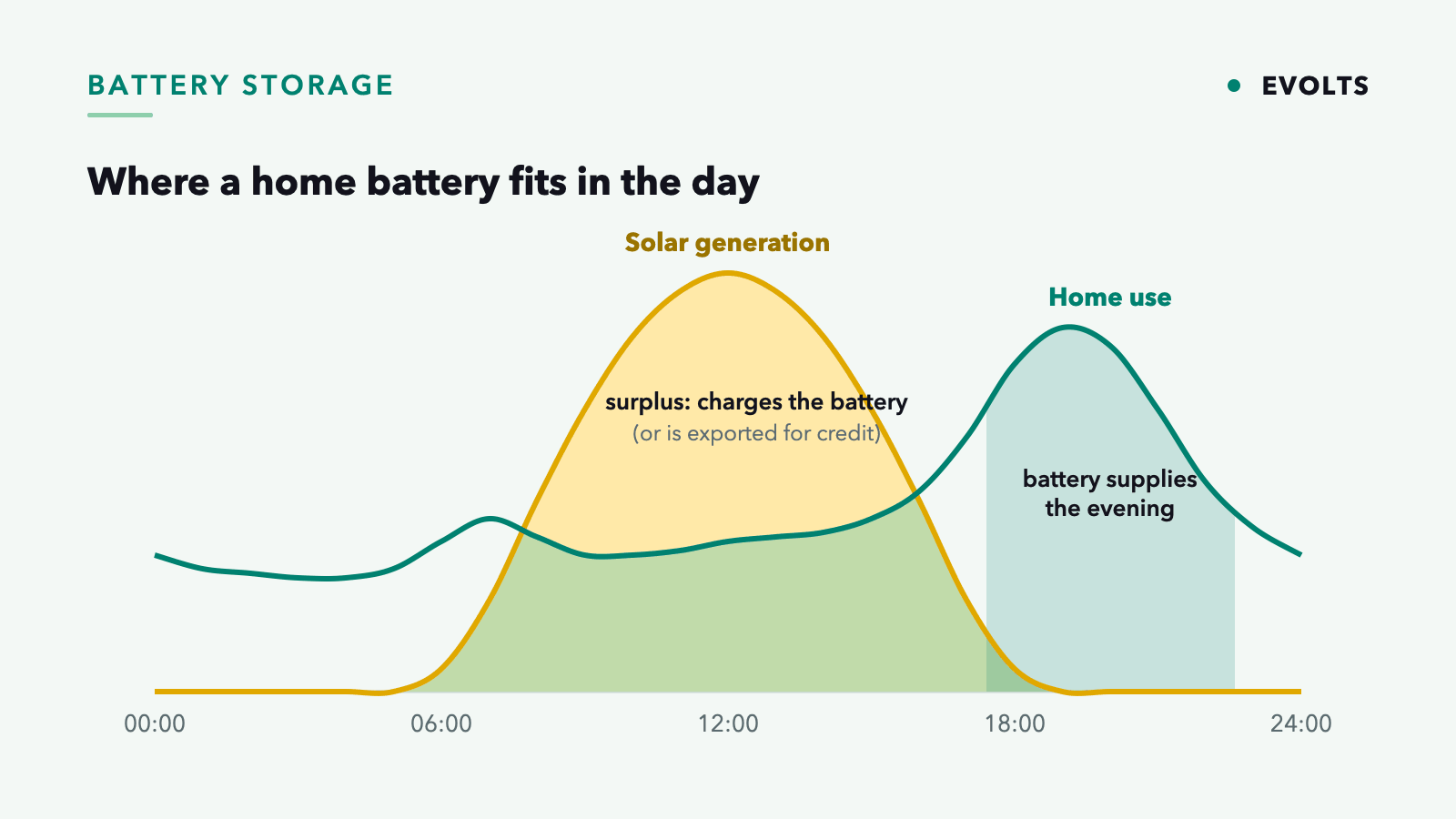
A home battery stores the solar electricity you would otherwise export, so you can use it in the evening. Under Malaysia’s Solar ATAP programme that is worth less than most battery advertising suggests, because exported energy already earns a credit on your bill. For most landed homes a battery is bought for backup or future-proofing, not for savings. There are exceptions, and they are worth checking before you decide.
Thinking about a battery? Send Evolts your last three TNB bills and, if you already have solar, your inverter’s monthly export figures. An engineer will tell you how much surplus a battery would actually capture, and whether it is worth adding now or later.
The short answer
A home battery tends to make sense in three situations:
- Your exports regularly exceed your imports. Under Solar ATAP, credit you cannot use within the month is forfeited. Storing that surplus is where a battery earns the most.
- You need power through outages for specific loads (a home office, medical equipment, a fridge or freezer of stock), and you accept paying for that resilience.
- You are planning a change, such as an electric vehicle charged at night, that will shift a lot of consumption out of daylight hours.
For a household that uses most of its solar during the day and imports in the evening, a battery mostly converts exports worth one price into evening use worth a slightly higher price. The difference is small, as the numbers below show.
How Solar ATAP values the surplus you export
The rules are set by the Energy Commission (Suruhanjaya Tenaga) in its Solar ATAP guidelines, in force since 1 January 2026:
- Exports from a home are credited at the Energy Charge only: 27.03 sen/kWh, or 37.03 sen/kWh if the household uses more than 1,500 kWh a month (§3.6.1). Every kWh you import costs the Energy Charge plus the Capacity Charge (4.55 sen) and the Network Charge (12.85 sen): 44.43 sen/kWh in total on the general tariff.
- Credits only offset the same month’s imports, up to a cap called the Maximum Allowable Quantity (system kWac × 5 sun-hours × days in the billing period). Anything above that is forfeited, not carried forward.
- Credits cannot offset the Automatic Fuel Adjustment (AFA), which has been a surcharge since May 2026.
- Batteries are allowed. The guideline says a battery energy storage system may be incorporated as part of the solar installation (§11). Your application must include the battery design if you use one.
So the “spread” a battery can capture is the gap between what an imported kWh costs and what an exported kWh earns. Our NEM 3.0 versus Solar ATAP comparison explains why this gap exists.
What a stored kWh is actually worth
A battery also loses energy on the way in and out. Manufacturers quote this as round-trip efficiency. Tesla’s Powerwall 3 datasheet, for example, gives 89% for energy that passes through the battery (its higher 97.5% figure applies to solar going straight to the house). BYD quotes at least 96% for its HVS battery. Using those two figures and the TNB general tariff:
| If the stored solar would otherwise have been… | Value of each kWh stored (89% / 96% efficiency) |
|---|---|
| Exported and credited, household under the AFA exemption threshold | 12.5 / 15.6 sen |
| Exported and credited, household paying AFA (3.60 sen in November 2026) | 15.7 / 19.1 sen |
| Forfeited (exports above that month’s imports or the cap) | 39.5 / 42.7 sen |
Our calculation from TNB’s published rates and the two datasheets. It excludes service tax and the KWTBB levy, and assumes the battery is full each evening.
To see what that means in a year: a 7 kWh battery that is filled and emptied every day stores about 2,555 kWh. At 12.5–19.1 sen that is roughly RM320–490 a year. Divide the installed price you are quoted by that figure for a simple payback. At an illustrative RM20,000 it is more than 40 years, which is longer than any battery warranty. The arithmetic only turns in a battery’s favour when a large share of your surplus would otherwise be forfeited.
Why charging from the grid at night barely pays
Under TNB’s time-of-use (ToU) tariff, the off-peak energy rate is 24.43 sen and the peak rate is 28.52 sen, but the Capacity and Network Charges apply to every kWh either way. Charging off-peak and discharging at peak therefore gains about 2 sen per kWh at 96% efficiency, and loses about 1 sen at 89% (our calculation). Grid arbitrage is not a reason to buy a home battery in Malaysia today.
Backup: what a battery can and cannot do in an outage
Most grid-connected solar systems switch off during a power cut. That is a safety requirement (anti-islanding), not a fault. A battery only keeps your lights on if the system is designed to isolate your home from the grid and supply chosen circuits, which needs the right hybrid inverter and switching equipment. Ask which circuits will be backed up and for how long.
Put outages in context too. The Energy Commission reports that the average customer in Peninsular Malaysia lost supply for about 47 minutes in 2025 (ST performance booklet). Your street may be very different, and that local history is what should decide the backup case.
How to read a battery datasheet
- Usable energy (kWh), not nominal capacity. This is what you can actually draw.
- Round-trip efficiency through the battery, not “solar-to-home” efficiency.
- Cycle life and its test conditions. A headline such as 6,000 cycles is usually measured at 25 °C. Check the warranty throughput as well. One 5.12 kWh battery advertising at least 6,000 cycles warrants 16 MWh, about 3,100 full cycles (our calculation from the brochure). The warranty is what is guaranteed.
- Temperature range and derating. Batteries age faster when hot. Some reduce output above 40 °C, which matters in a Malaysian garage or on a west-facing wall.
- Ingress rating. An IP20 enclosure is for indoor use only. Outdoor units need a higher rating.
- Chemistry. Most current home batteries use lithium iron phosphate (LFP), which is more tolerant of heat and abuse than older lithium chemistries.
The 2026 safety rules for home batteries
In May 2026 the Energy Commission issued Battery Energy Storage System (BESS) Safety Guidelines that apply to lithium-ion batteries, including residential systems connected to the grid. In summary:
- Outdoor installation is recommended. If a battery must go indoors, fire suppression and Fire and Rescue Department (Bomba) requirements apply.
- Battery packs must be evaluated to IEC 62619 or IEC 63056, and thermal-runaway protection tested to UL 9540A or the fire authority’s requirements.
- Temperature control and unobstructed ventilation are required.
- Installation and testing are certified by a Competent Person. Maintenance is done by or under a competent person, with records kept.
- The Energy Commission states that battery installations of 5 kW and above are subject to its licensing requirements.
For larger battery rooms in commercial buildings, see our note on battery storage and Bomba requirements.
Add one now, or later?
If the numbers do not justify a battery yet, you can still plan for one. Choose a hybrid inverter that can accept a battery later, leave wall space with ventilation away from bedrooms, and keep your monthly export records. The most useful input is your own data: build a daytime usage record before sizing anything. Note that the government’s SuRIA Home rebate (RM600 per kWac of solar, up to RM3,000) applies to the solar system; there is no home battery incentive today.
Businesses face a different calculation, built around maximum demand charges rather than export credits. See battery energy storage systems for commercial and industrial sites and peak shaving with a battery.
What happens next
- Send your records. Three recent TNB bills, plus inverter export figures if you already have solar.
- Engineer review. We estimate how many kWh a battery would capture in a typical month, including any forfeited exports.
- A straight answer. Now, later, or not at all, with the reasoning written down.
Frequently asked
Is a home battery worth it in Malaysia under Solar ATAP?
Usually not on bill savings alone, because exported solar already earns the Energy Charge. It can be worth it if much of your surplus is forfeited each month, if you need backup for specific circuits, or if your usage is moving to the evening.
How long will a 10 kWh battery last?
It depends on what it powers. Divide usable kWh by your evening load in kW: a home drawing 1 kW through the evening would run for roughly 9 hours on 10 kWh at 89% efficiency, before any reserve the battery holds back.
Can I export battery power to TNB under Solar ATAP?
The Solar ATAP guideline allows a battery as part of the installation, but we found no explicit rule on crediting energy discharged from a battery. Confirm with the scheme documents and TNB before planning around it.
Which battery chemistry is best for home solar?
Lithium iron phosphate (LFP) is the common choice for homes because it tolerates heat better. Whatever you choose, check the warranty throughput, temperature range and ingress rating.
Do I need a licence for a home battery?
The Energy Commission states that battery installations of 5 kW and above are subject to its licensing requirements, and its 2026 safety guidelines apply to residential lithium-ion systems. Your installer should handle the submissions.
Find out what a battery would really capture
Send your TNB bills and any solar export data. An engineer will review them and tell you whether a battery makes sense for your home now, later or not at all.
Ask about a battery WhatsApp +60 10-661 1132
Engineer response within 1 working day · No obligation
Sources
- Suruhanjaya Tenaga, Guidelines for Solar ATAP (2025)
- Suruhanjaya Tenaga, BESS Safety Guidelines GP/ST/No.62/2026
- TNB, Guide to Electricity Tariff
- Tesla, Powerwall 3 datasheet
- BYD, Battery-Box Premium HVS datasheet V1.4
- Deye, SE-G5.1 Pro-B brochure (2026)
- SEDA, SuRIA Home rebate
- Suruhanjaya Tenaga, Performance Booklet (SAIDI 2025)


